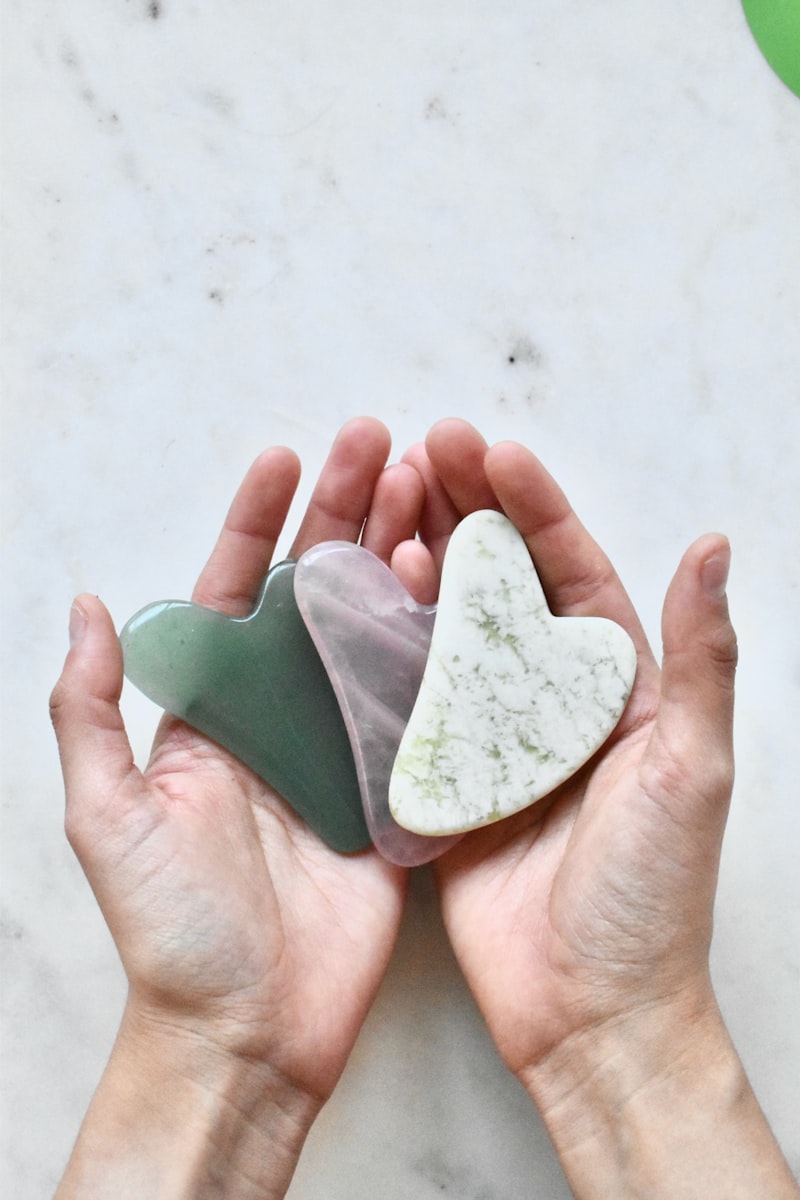
How to Use a Gua Sha: The Facial Massage Technique Everyone's Talking About
A licensed esthetician's real guide to facial gua sha — the correct technique, what it actually does, and how to choose between jade, rose quartz, and steel.
By Rita Almusa, Licensed Master Esthetician — 20+ years of experience
Introduction
Gua sha has gone from a traditional Chinese medicine practice to one of the most talked-about tools in modern skincare, and with that popularity has come a lot of confusing, contradictory advice. As a licensed Master Esthetician, I want to walk through the actual technique properly — what gua sha realistically does, how to do it safely, and why the ritual itself might matter more than any dramatic “results” you’ve seen online.
What Gua Sha Actually Is
Gua sha is a facial massage technique using a smooth, flat stone tool to apply pressure and scraping motions across the skin. It originated in traditional Chinese medicine, where it was used more broadly across the body for tension and circulation. The facial version adapts the same principle — a flat stone edge glided across the face and neck — into a gentler, skincare-focused ritual.
Does Facial Gua Sha Really Work?
I want to be direct about this rather than overselling it: gua sha can help reduce the appearance of puffiness and temporarily improve the look of facial contour by supporting lymphatic drainage — the movement of built-up fluid out of tissue. It does not alter your bone structure or redistribute fat, despite what some “instant facelift” claims suggest online. Results also vary based on individual factors like water retention. What’s consistently true, in my professional experience and for most people who stick with it, is that the practice is genuinely relaxing and mindful, which has its own real value even setting aside any cosmetic effect.
Choosing Your Tool: Jade vs. Rose Quartz vs. Steel
- Jade is gentler on the skin and a good option if you have any joint sensitivity, since it requires slightly less pressure to glide smoothly.
- Rose quartz offers a similar gentle glide to jade, with the same natural cooling property — the choice between the two is largely personal preference. If you’d rather roll than scrape, my rose quartz roller guide covers that gentler alternative in more detail.
- Stainless steel gives a more intense massage sensation that many people find more effective for muscle tension relief, and it’s non-porous, meaning it won’t harbor bacteria the way a porous stone potentially could over time.
Whichever material you choose, the most important quality factor is a genuinely smooth surface with no chips or rough edges, since those can drag or even scratch skin during use.
How to Use It, Step by Step
1. Apply a Facial Oil or Serum First
Gua sha needs a smooth, lubricated surface to glide properly — using it on dry skin causes tugging and dragging, which isn’t comfortable and can actually irritate skin rather than help it. A facial oil or a serum with some slip, like the MintPear Collagen Serum, works well here — using a moisturizing product also means you’re getting a skincare benefit alongside the massage itself, since the gua sha motion helps work the product into skin.
2. Start at the Center of Your Face
Begin at your chin or the bridge of your nose, holding the tool at a low angle (closer to flat against the skin than perpendicular) for the smoothest glide.
3. Move Upward and Outward for Anti-Aging Benefits
For a lifted, toned effect, glide upward and outward — from your jaw toward your ear, from the corner of your mouth toward your temple, from your brow bone toward your hairline. This works with gravity’s resistance rather than following it.
4. Move Downward on the Neck for Lymphatic Drainage
This is a genuine technique distinction worth knowing: for de-puffing and lymphatic support, the neck specifically should be massaged in a downward motion, following the body’s natural lymphatic drainage pathway toward the collarbone. Facial strokes for anti-aging go upward; neck strokes for drainage go downward.
5. Repeat Each Area a Few Times
Three to five passes per area is generally enough. This isn’t a treatment where more pressure or more repetitions equals better results — it’s a light-to-medium pressure technique.
6. Finish at the Collarbone
End your session with gentle strokes toward and along the collarbone, which is where lymphatic fluid ultimately drains.
The Beauty Tips Guide
20+ years as a Licensed Master Esthetician and Makeup Artist, condensed into one guide.
Common Mistakes to Avoid
- Using it on completely dry skin. This causes tugging and can irritate skin rather than help it — always use oil or serum underneath.
- Pressing too hard. Gua sha is a massage technique, not a scraping or exfoliation tool. Firm, even pressure is enough; you shouldn’t feel pain.
- Going downward on the face when working for a lifted effect. Mixing up the direction undermines the specific benefit you’re going for in that area.
- Expecting a permanent, dramatic transformation. Any visible effect from a single session is largely temporary, from increased circulation and reduced puffiness — not a structural change.
- Rushing through it. Part of gua sha’s value is the slow, mindful pace — treating it as a two-minute chore misses much of what makes the practice worthwhile.
Building It Into Your Routine
Gua sha works well as either a morning de-puffing ritual or an evening wind-down practice — there’s no single correct time of day. A five-to-ten minute session two to three times a week is enough to build a consistent habit without it feeling like an extra chore layered onto an already long routine. If you’re new to it, start with just the basic upward-and-outward face strokes before adding the more detailed neck and collarbone sequence.
Pro Tips
- Store your tool in the fridge for an extra cooling, de-puffing sensation, especially nice first thing in the morning.
- Clean your gua sha tool after every use with a gentle cleanser or alcohol wipe, particularly important since it’s in direct, repeated contact with your skin.
- Use consistent pressure, not increasing pressure, throughout each stroke — ramping up pressure partway through a stroke can feel jarring rather than relaxing.
- Pair it with a product you’d use anyway rather than buying a separate “gua sha oil” — a good facial oil or lightweight serum does the job.
How Often Should You Actually Do This?
Daily use is fine for most people and is where the most consistent de-puffing benefit tends to show up, but two to three sessions a week is enough to build a genuine habit if daily feels like too much. What matters more than frequency is consistency over time — a rushed daily session with poor technique won’t out-perform a slower, more attentive session done a few times a week.
Frequently Asked Questions
Can gua sha cause bruising or broken capillaries? Used with appropriate light-to-medium pressure, it shouldn’t. If you notice bruising, redness that doesn’t fade quickly, or visible broken capillaries, you’re pressing too hard or moving too aggressively — ease off significantly or stop and consult a dermatologist if it persists.
Is gua sha safe for sensitive or acne-prone skin? Generally yes, since it’s a low-pressure, non-abrasive technique, but avoid rolling directly over active breakouts or irritated areas, and always work with clean hands and a clean tool.
How is gua sha different from a jade roller? A gua sha stone is flat and used with scraping-style strokes, offering a more intense massage sensation. A jade roller is round and rolls across the skin, offering a gentler, more passive massage that some people find easier to use for applying product.
Can gua sha replace professional facial treatments? No — it’s a genuinely useful at-home addition for circulation, relaxation, and temporary de-puffing, but it doesn’t replace the results of professional treatments that work more directly on skin’s deeper structure.
Conclusion
Facial gua sha earns its popularity honestly when you understand what it’s actually doing: supporting circulation and lymphatic drainage, and offering a genuinely mindful, calming ritual, rather than delivering an instant facelift. Watch the full tutorial above to see the exact strokes and pressure in motion, and give the practice a few consistent weeks before deciding what it’s doing for you — both the visible effects and the relaxation benefit tend to build with consistency. ✨
Related Posts
At-Home Microneedling: What It Can (and Can't) Do for Acne Scars and Pores
A licensed esthetician's honest, safety-first guide to at-home microneedling — realistic expectations, proper technique, and when to see a professional instead.
Do Facial Steamers Actually Work? An Esthetician's Honest Guide
A licensed esthetician explains what a facial steamer actually does for your skin, how to use one safely, and whether it's worth adding to your routine.
My Nighttime Skincare Routine: An At-Home Facial Anyone Can Do
A licensed esthetician's full nighttime skincare routine — a step-by-step at-home facial ritual for glowing skin, in the right order.
How to Shave Facial Hair at Home Without Breakouts or Irritation
A licensed esthetician's guide to safe at-home dermaplaning — removing peach fuzz without acne, razor bumps, or irritation.